

Draft Status Assessment of the Moths of Northern Ireland
Client: CEDaR (Centre for Environmental Data and Recording) | Delivered: July 2026 | With: Adam Mantell, Arctia Ecology
Overview
CEDaR commissioned BioSpatial Insights to produce the first provisional rarity and scarcity assessment of Northern Ireland’s macro- and micromoths. The work used an automated, repeatable method to classify over 1,200 taxa from more than 650,000 records (1987–2024) as Rare, Scarce A or Scarce B. These are the first step towards a full status assessment.
The challenge
Northern Ireland had no equivalent of the rarity statuses used in Great Britain, and the Irish Red Lists assess extinction risk, not distribution. Northern Ireland also has few hectads (188), the grid squares used for comparable assessments elsewhere. A new approach was needed that was consistent with Ireland-wide work but suited to the data available.
Approach
Data preparation: Macro- and micromoth datasets were merged and standardised in R. Taxon names were matched to preferred Taxon Version Keys via the NBN API, and records of subspecies and aggregates were handled so each taxon’s true record count was reflected.
Resolution: After comparing grid sizes, 5 km × 5 km quadrants (668 across Northern Ireland) were chosen as the best balance of precision and data coverage.
Thresholds: Rare (7 or fewer quadrants), Scarce A (8–17) and Scarce B (18–33) were set to mirror the land-area proportions used in the Ireland assessment.
Distribution description: Each taxon was described by geographic skew using percentile-based rules and displayed using box-and-whisker plots, with DBSCAN clustering to flag patchy distributions.
Abundance: Normalized Cell Abundance Score (nCAS) showed that rarity and local abundance are not the same thing. Some restricted taxa are numerous where they occur.
Reproducibility: Everything was built from R scripts and PostgreSQL functions, so the analysis can be rerun as data improves.
Key findings
1,201 taxa analysed; 727 provisionally assigned a status (381 Rare, 176 Scarce A, 170 Scarce B).
75% of micromoths received a status, against 38% of macromoths. This most likely reflects recording effort and detectability as much as true rarity.
Records are heavily skewed towards urban centres and well-visited sites, and some inland quadrants have no records at all. The report identifies priority areas for survey.
Of the macromoths assessed using this approach for Ireland, every taxon rated Rare there was also Rare in Northern Ireland, showing broad agreement.
Limitations and next steps
These outputs are deliberately provisional. Recording bias, cryptic taxa and the inclusion of vagrant and non-native species mean expert review is needed before statuses are finalised. Many taxa flagged as rare or scarce that were also covered by the Northern Ireland Priority Species assessments were already listed as Data Deficient, suggesting data gaps rather than genuine rarity.
Further work is planned using Frescalo to account for imperfect detection and assess range change, which would feed into any future assessment. The approach can also be extended to other taxonomic groups.
Tools: R, PostgreSQL, NBN API, DBSCAN, QGIS
Image used on the main portfolio page: European Pine Shoot Moth Rhyacionia buoliana
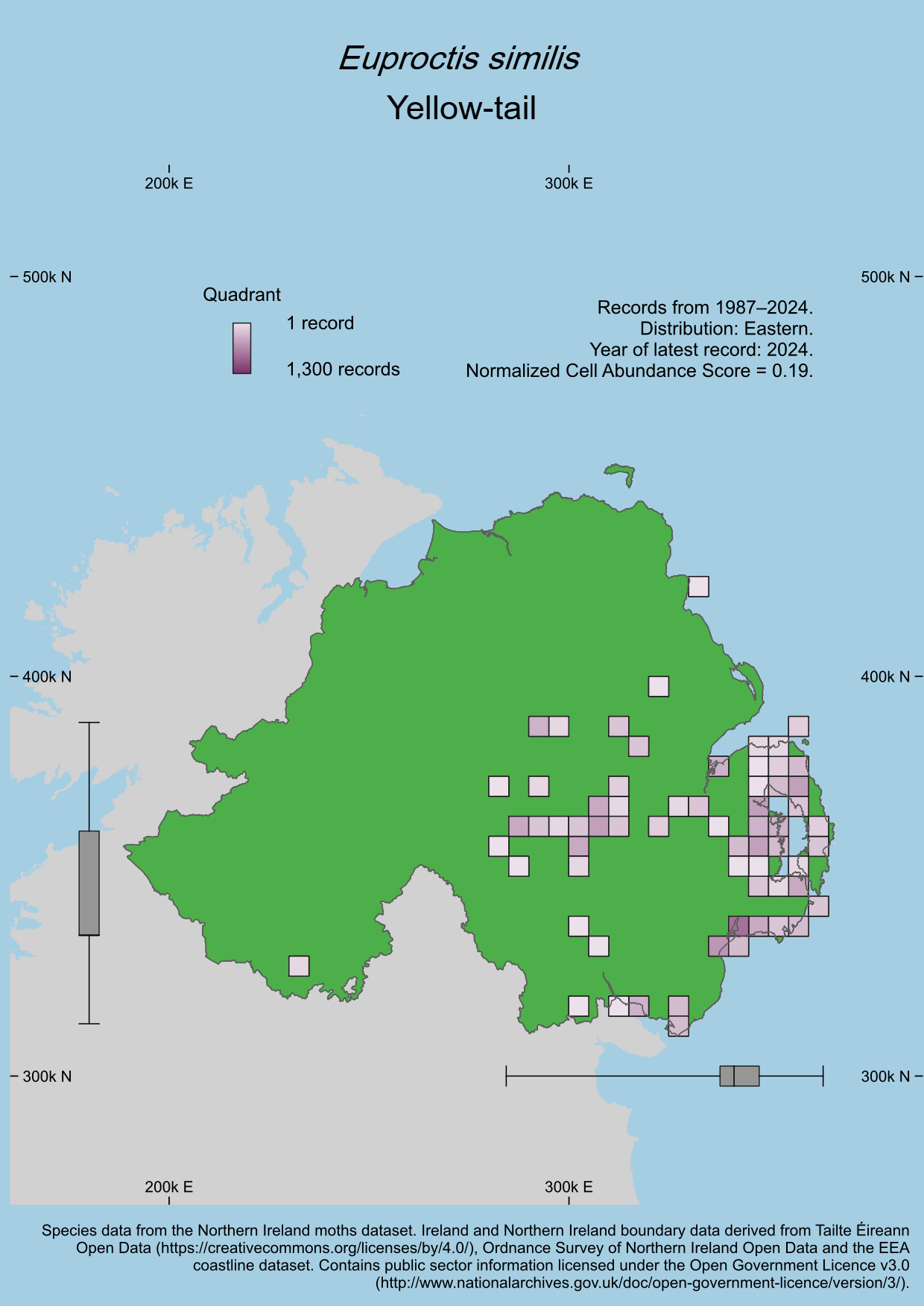
Distribution of the Yellow-tail Euproctis similis in Northern Ireland.
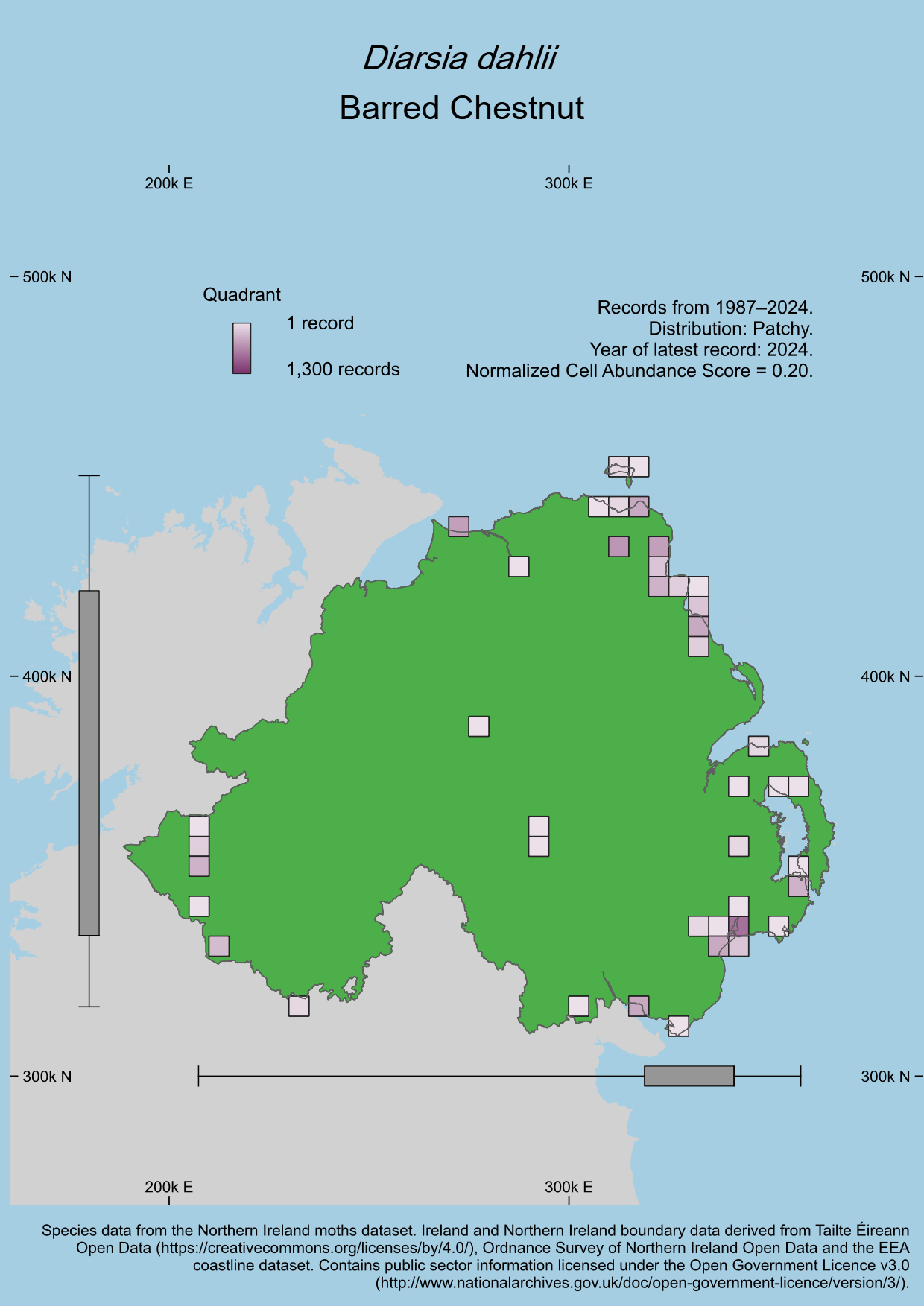
Distribution of the Barred Chestnut Diarsia dahlii in Northern Ireland.
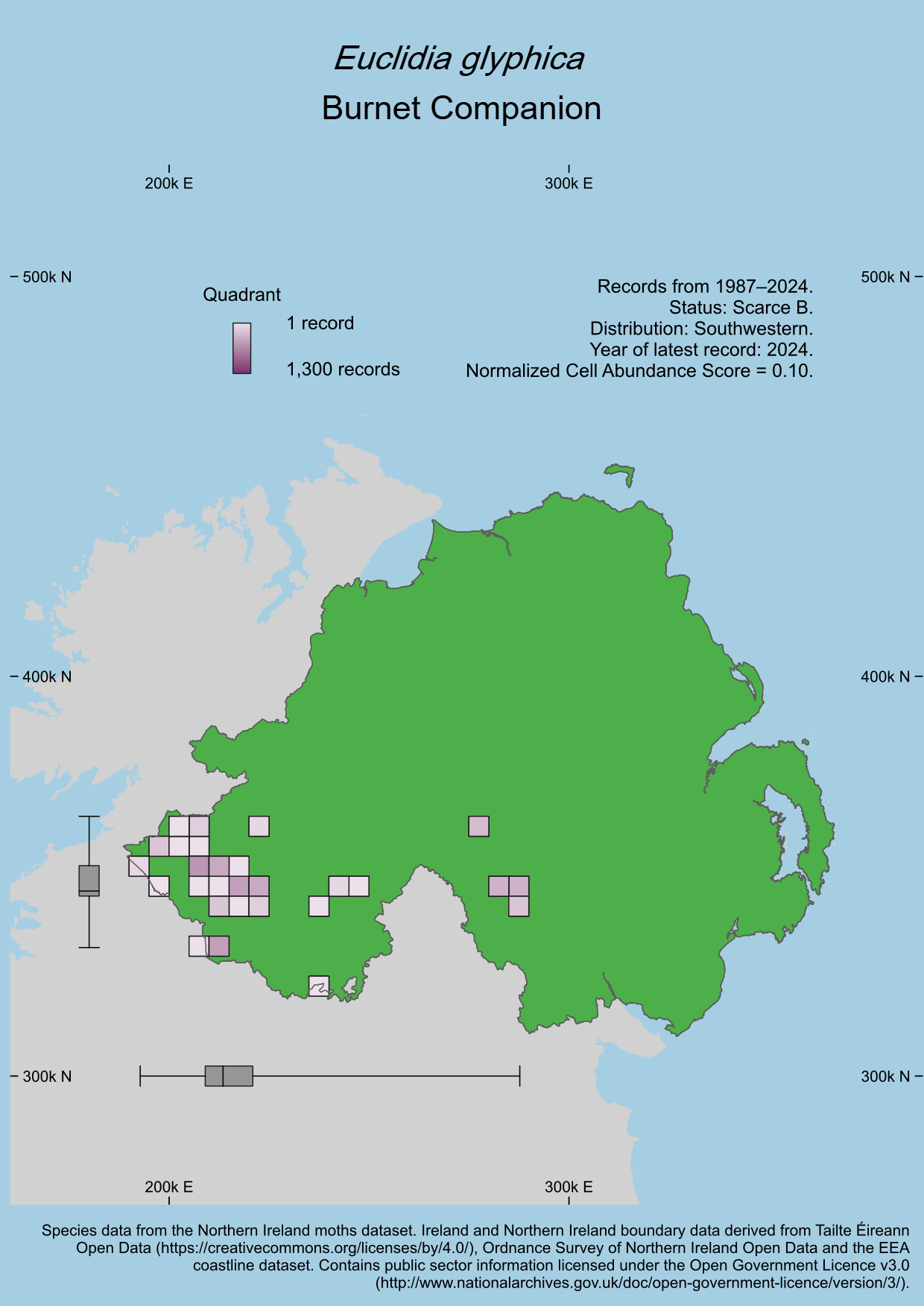
Distribution of the Burnet Companion Euclidia glyphica in Northern Ireland.
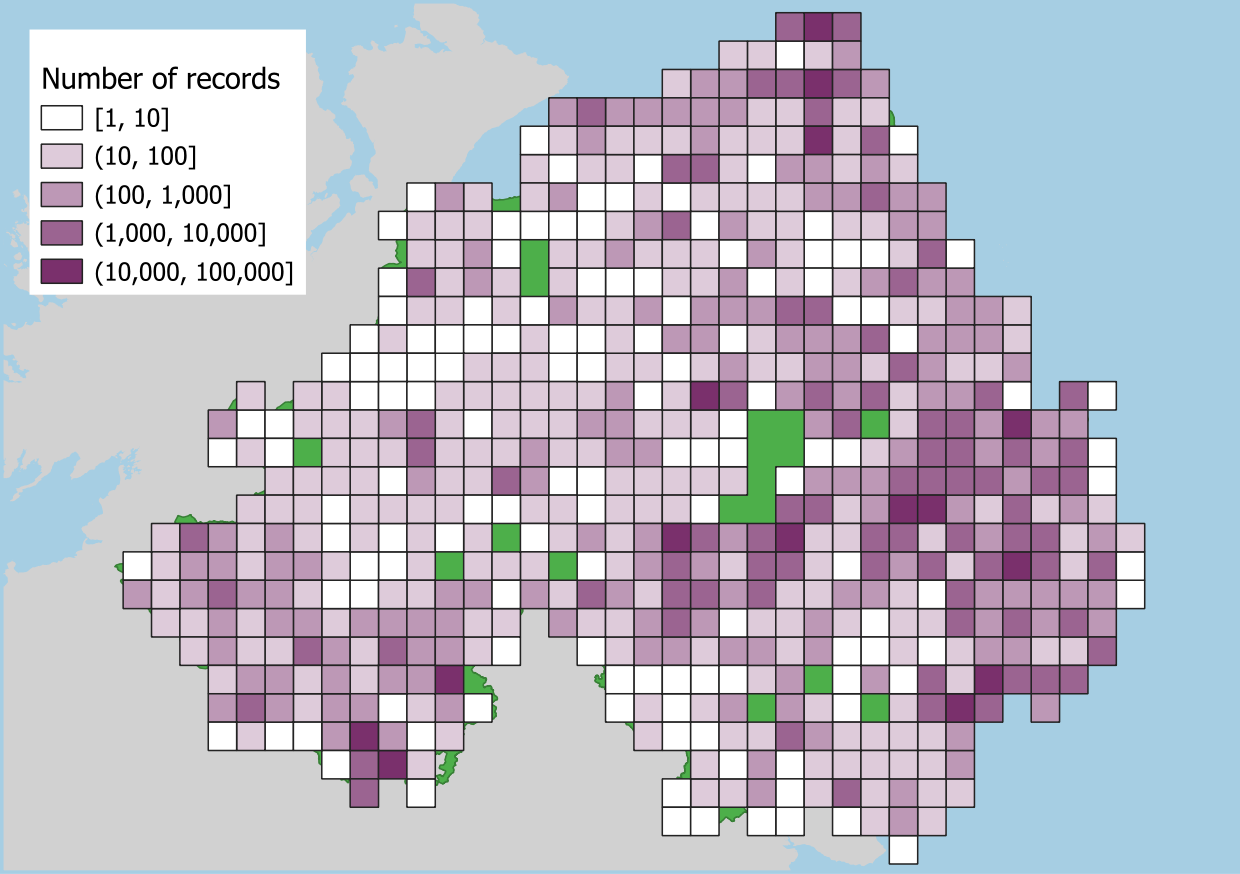
Number of moth records per quadrant in Northern Ireland. Ireland and Northern Ireland boundary data derived from Tailte Éireann Open Data (https://creativecommons.org/licenses/by/4.0/), Ordnance Survey of Northern Ireland Open Data and the EEA coastline dataset. Contains public sector information licensed under the Open Government Licence v3.0 (http://www.nationalarchives.gov.uk/doc/open-government-licence/version/3/).
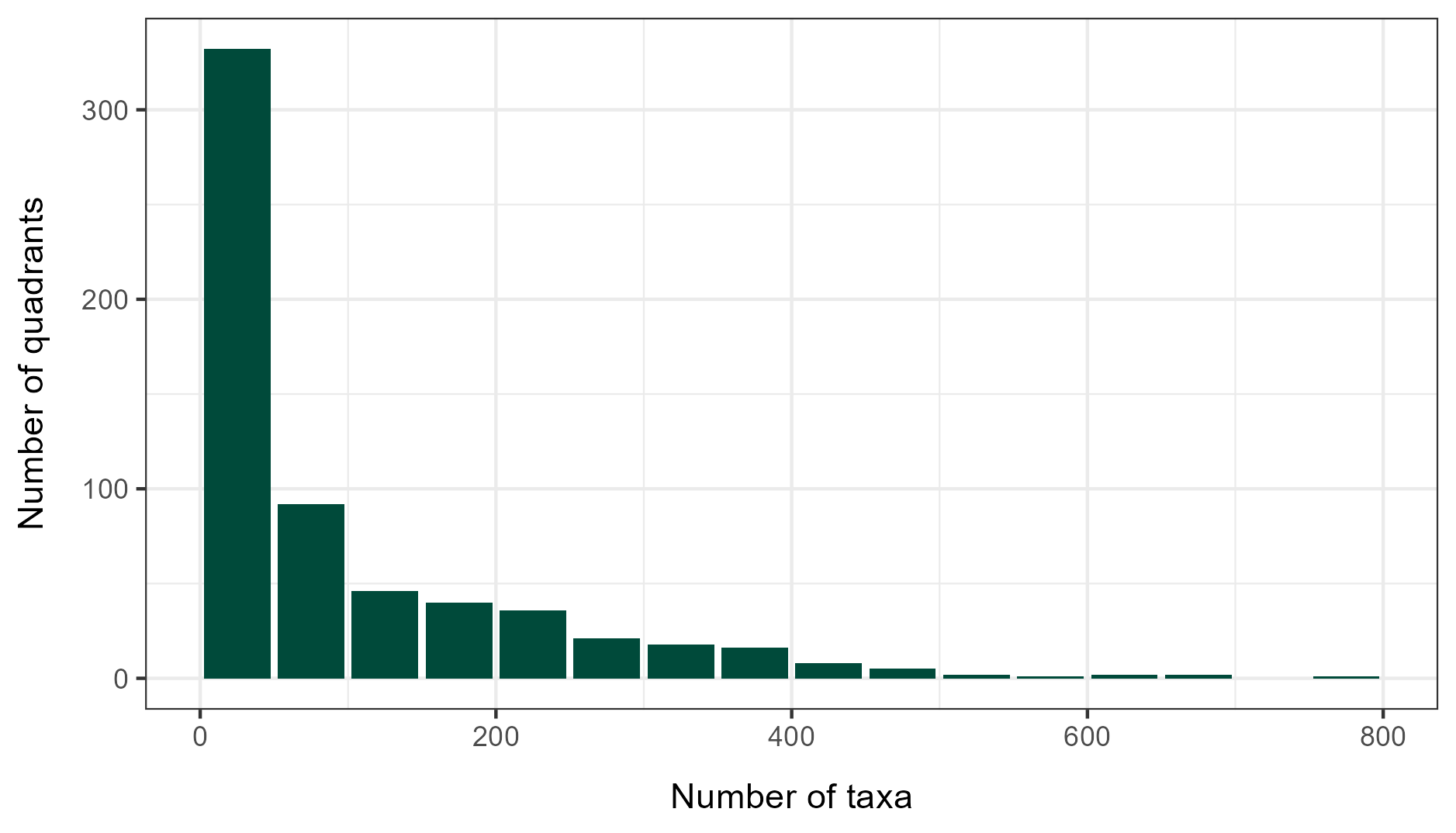
Number of moth taxa per quadrant in Northern Ireland.