Draft status assessment of Irish dragonflies and damselflies
BioSpatial Insights was commissioned by the Centre for Environmental Data and Recording (CEDaR) to produce a comprehensive status assessment of the rarity and scarcity of Ireland's dragonflies and damselflies (Odonata). This built on and developed an automated assessment methodology, producing a draft status assessment that is both robust and repeatable.
The dataset
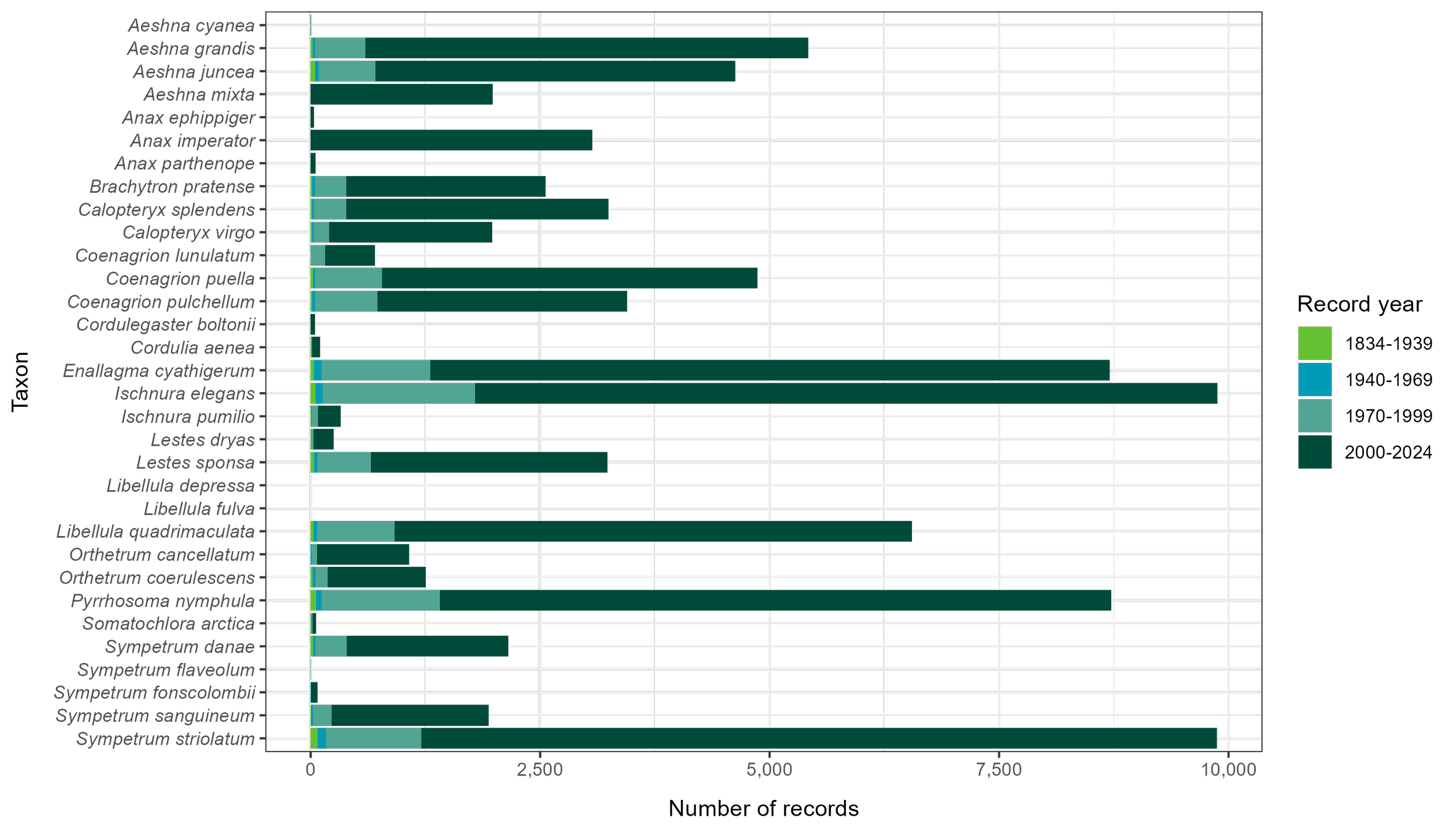
Records from the CEDaR and National Biodiversity Data Centre (NBDC) databases, comprising a total of over 86,000 records in the Dragonfly Ireland dataset, were imported into a PostgreSQL database.
30 species were assessed, covering all taxa with records from 1940 to 2024.
Data underwent rigorous validation, including spatial checks against the Irish landmass and Vice County boundaries to identify and resolve location errors.
Methods
Status thresholds were applied at hectad (10 km × 10 km) resolution, classifying taxa as Rare (≤10 occupied hectads), Scarce A (11–25 hectads) or Scarce B (26–50 hectads).
Analysis was run across three date ranges (1940–2024, 1970–2024 and 2000–2024) to assess how statuses varied over time and to identify potential local extinctions and gaps in recording coverage.
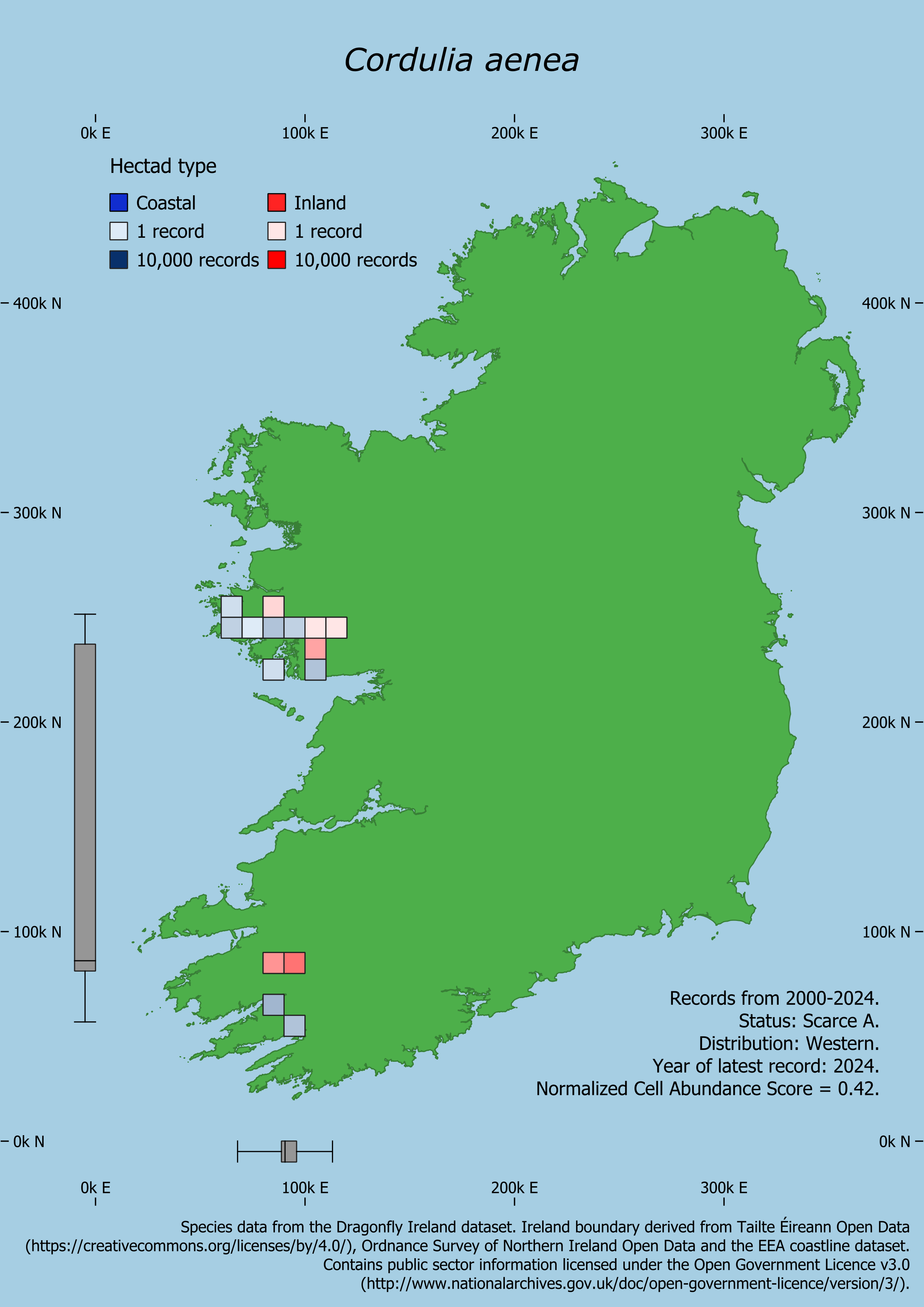
Geographic distributions were described objectively and illustrated using box and whisker plots, DBSCAN cluster analysis to identify patchy distributions, and coastal proximity thresholds.
A Normalised Cell Abundance Score (nCAS) was developed to provide a relative measure of species abundance across occupied hectads.
Data processing was productised as a suite of PostgreSQL functions, making the analysis significantly more repeatable and adaptable for future use with other taxonomic groups or geographic areas.
Key findings
One native species was assessed as Rare: the Northern Emerald Somatochlora arctica (also Red-listed as Endangered), confined to a small cluster of hectads in southwest Ireland.
One native species was assessed as Scarce A: the Downy Emerald Cordulia aenea (Endangered), with a western distribution.
One native species was assessed as Scarce B: the Scarce Emerald Damselfly Lestes dryas (Near Threatened).
Several vagrant species were also assigned rare or scarce statuses, including the Southern Hawker Aeshna cyanea, Golden-ringed Dragonfly Cordulegaster boltonii and Yellow-winged Darter Sympetrum flaveolum (Rare), and Vagrant Emperor Anax ephippiger, Lesser Emperor Anax parthenope and Red-veined Darter Sympetrum fonscolombii (Scarce).
Status classifications were consistent across all three date ranges for most species, reflecting the high quality and broad coverage of recent recording effort.
Full distribution maps and summary tables were produced for all taxa across all three time windows.
The project demonstrated the potential for broader application of the automated methodology to other taxonomic groups across Ireland, with the long-term goal of producing status assessments for all well-recorded groups, as well other geographic regions.