

Scottish Deer Vehicle Collision analysis
NatureScot has awarded BioSpatial Insights the contract to deliver Deer Vehicle Collision (DVC) analysis for 2025–2027. This long-term project has been undertaken since 2008, with some data stretching back to the 1990s. BioSpatial Insights’ Director, Mike Lush, has led DVC analysis for NatureScot since 2019.
The current contract involves:
Development and maintenance of a cloud-hosted PostGIS-enabled PostgreSQL database for DVC record and background data storage.
Annual collation of records of DVC incidents from a range of sources, including Trunk Road Operating Companies, statutory agencies, wildlife rescue organisations, recording schemes and police incident reporting.
Review, cleansing and importing the collated data into the DVC database, utilising R/PostgreSQL scripts to document the process and decisions made.
Analysis of spatiotemporal trends in DVCs and other Animal Vehicle Collisions using the statistical environment R.
Development of bespoke functions for some analysis, including moving window based identification of DVC hotspots.
Investigation and appraisal of novel potential sources of DVC data.
Production of a final report in 2028, covering data collated and trends since 2008.
Production of a non-technical summary that will present the key results using language, charts, maps and images that could be readily understood by a layperson.
Provision of DVC records and key outputs as web services (WMS/WFS) for use in third-party GIS.
Previous reports:
Lush, M.J. and Lush, C.E. 2023. Deer Vehicle Collision analysis 2019-2021. NatureScot Research Report 1329.
Lush, M.J. and Lush, C.E. 2026. Deer Vehicle Collision analysis 2022–2024. NatureScot Research Report 1400.
Image used on the main portfolio page © Paul Reynolds, New Arc Wildlife Rescue.
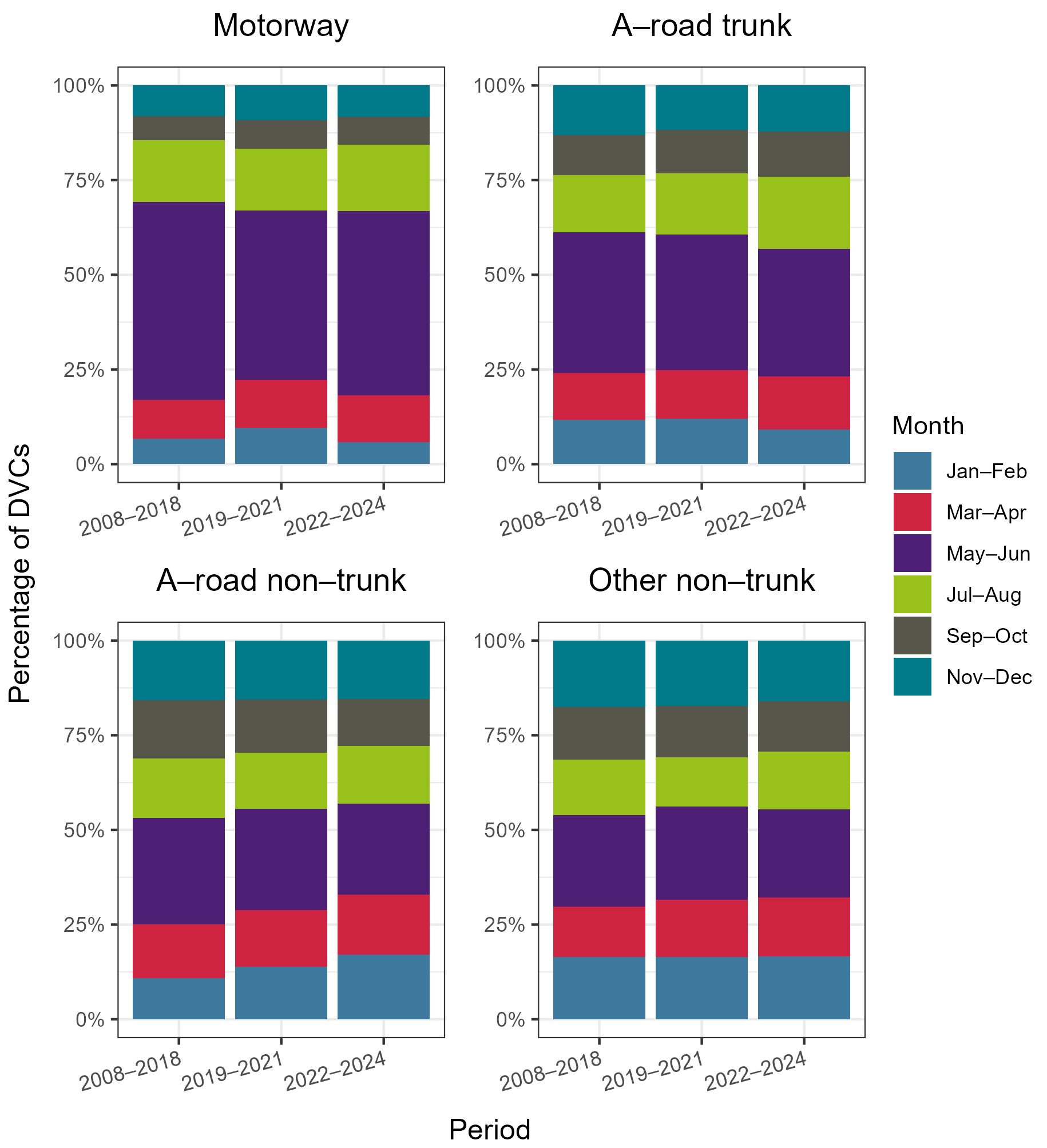
Seasonal patterns of DVCs on different road types.
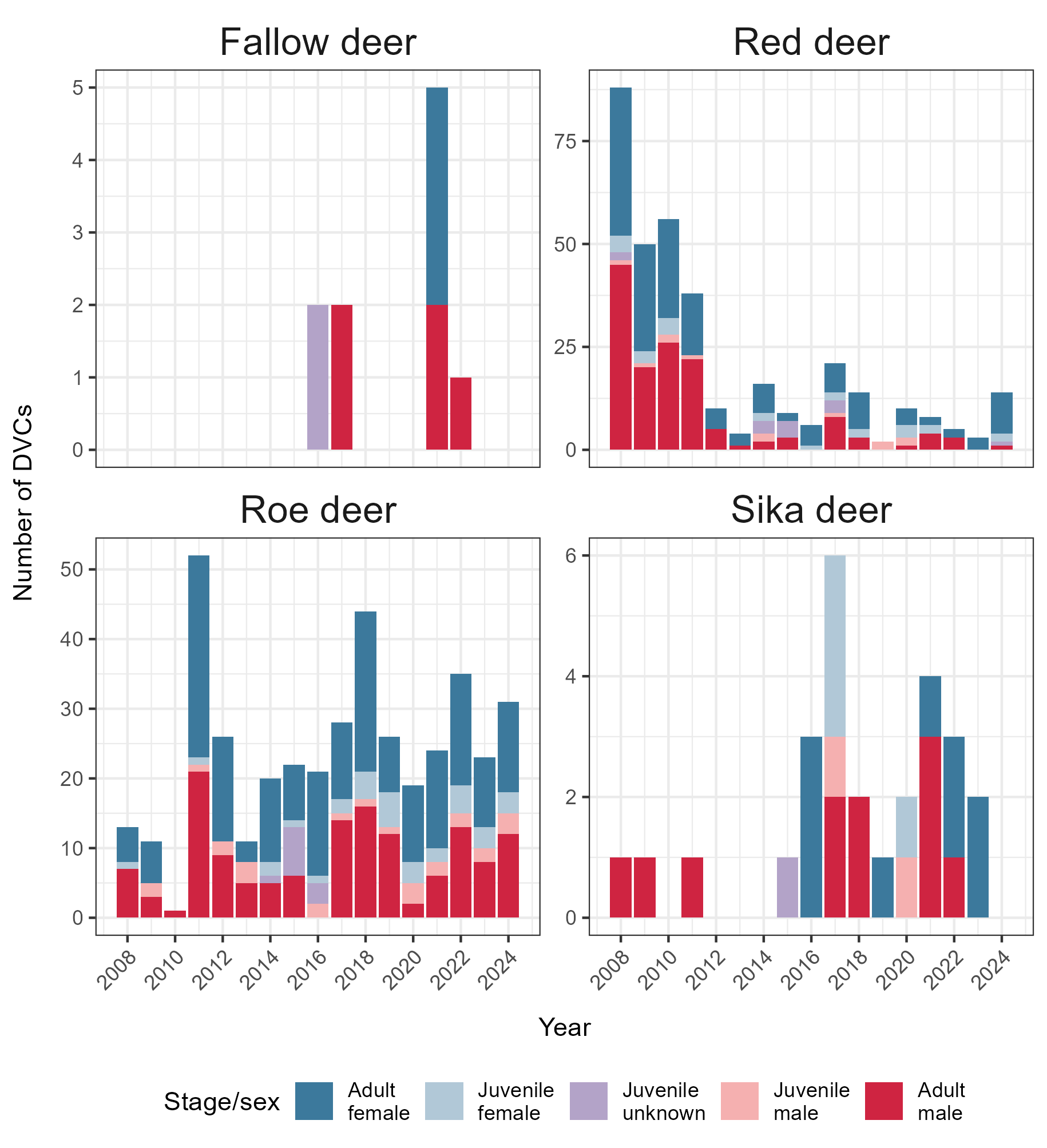
Numbers of DVCs where species, stage and sex were accurately recorded.