

Analysis of trends in Irish dragonflies and damselflies, 2000–2024
The third of three projects on Irish dragonflies and damselflies (Odonata) in 2025, BioSpatial Insights was commissioned by the National Biodiversity Data Centre (NBDC) to explore specific aspects of the DragonflyIreland 2000–2003 and Dragonfly Ireland 2019–2024 datasets, comparing the two periods of intensive recording to address three questions:
Whether apparent shifts in flight periods were real.
Whether the rapid range expansions of the Emperor Dragonfly Anax imperator and Migrant Hawker Aeshna mixta were associated with rising temperatures.
What environmental factors drive Odonata species richness at the hectad (10 km × 10 km) scale.
Throughout, particular care was taken to account for the variable recorder effort and spatial bias inherent in large citizen science datasets.
Flight period changes
14 species were assessed for changes in flight period using binomial Generalised Additive Models (GAMs) fitted to effort-weighted detection data, with hectad included as a random effect to account for spatial variation in recording intensity.
Simple statistical tests suggested earlier flight periods for all species, but these were considered unreliable because they took no account of recorder effort.
The more robust GAM-based approach detected clear flight period advances in only three species: Banded Demoiselle Calopteryx splendens (approximately 1–2 days earlier), Beautiful Demoiselle C. virgo (approximately 1 day) and Common Blue Damselfly Enallagma cyathigerum (less than 1 day).
For several early-emerging species, apparent lower survey effort at the start of the season in 2000–2003 limited the models' ability to detect possible shifts, so the true picture may be more nuanced than the results suggest.
The GAMs also revealed that the detection probability for five species – Brown Hawker Aeshna grandis, Banded Demoiselle, Common Blue Damselfly, Blue-tailed Damselfly Ischnura elegans and Variable Damselfly Coenagrion pulchellum – was lower in 2019–2024, a possible indicator of declining abundance that warrants monitoring attention.
Range expansion and climate
The striking range expansions of the Emperor Dragonfly and Migrant Hawker since their establishment in Ireland around 2000 were explored using linear models relating change in predicted hectad occupancy (derived from Frescalo analysis) to changes in temperature and rainfall, supplemented by Maxent species distribution models.
Both species showed strong statistical associations with rising temperatures, with rainfall also influential.
However, Maxent modelling indicated that suitable climatic conditions already existed across most of Ireland at the time of initial colonisation. This is consistent with what would be expected for two highly mobile, newly established species progressively spreading to occupy available habitat – a process that will naturally correlate with any environmental variable that changes over the same period, including temperature.
The models were best understood as exploratory. Future work could usefully focus on the role of dispersal dynamics and distance from the initial colonisation point.
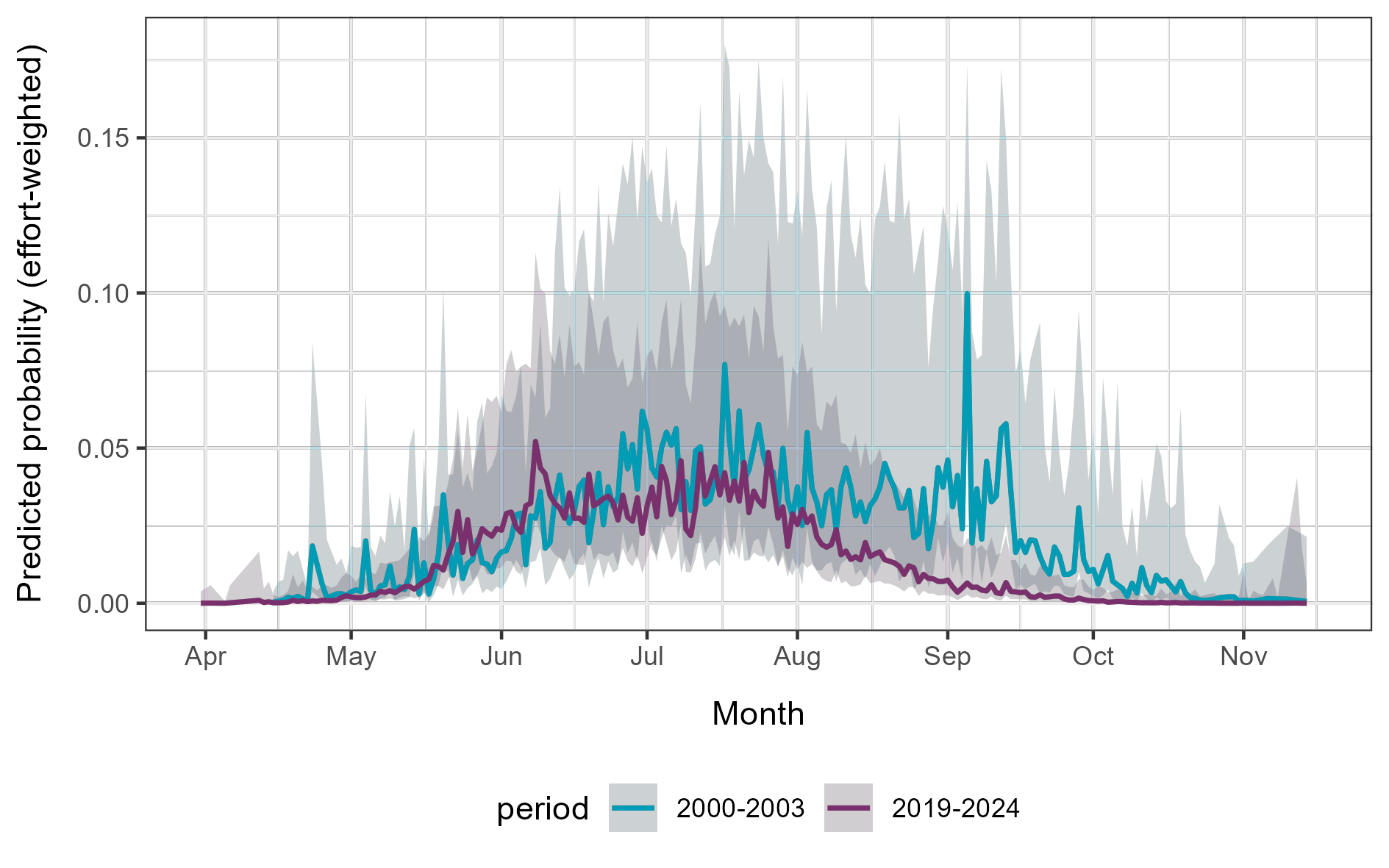
GAM predicted flight curves for Banded Demoiselle Calopteryx splendens in 2000–2003 and 2019–2025 with 95% confidence intervals.
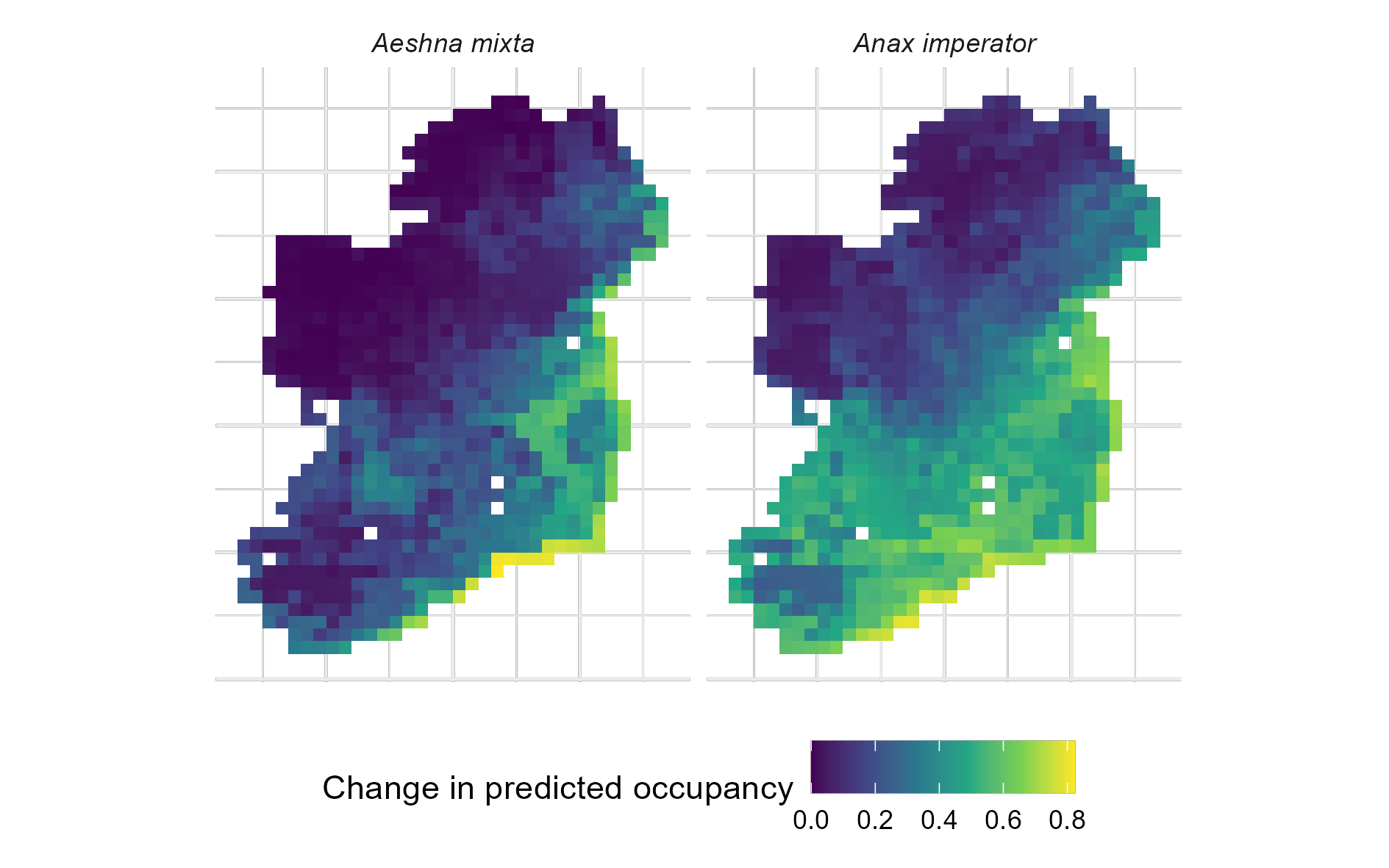
Change in predicted occupancy of Migrant Hawker Aeshna mixta (left) and Emperor Dragonfly Anax imperator (right) between 2000–2003 and 2019–2024.
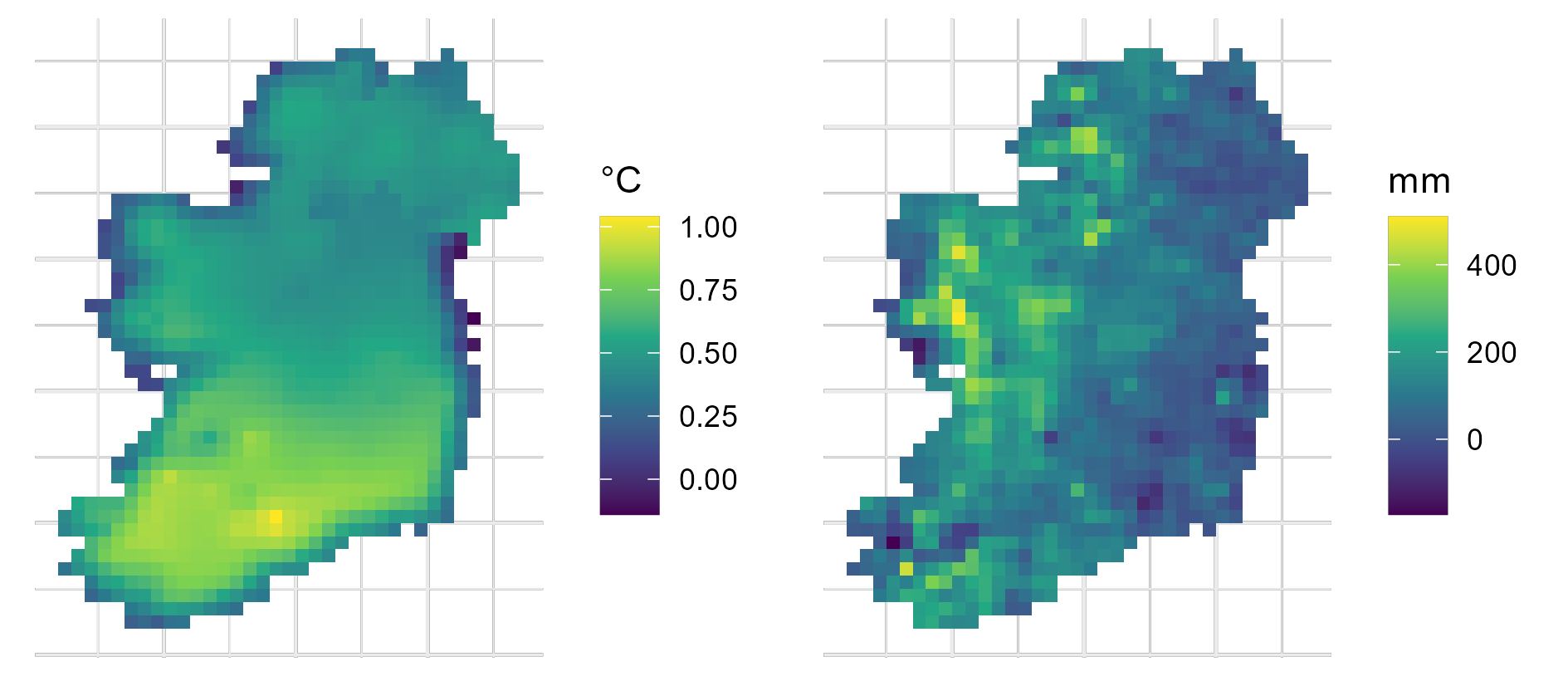
Change in temperature and rainfall in Irish hectads between 2000–2003 and 2019–2024.
Species richness
Modelled species richness derived from Frescalo outputs was analysed against a range of environmental, climatic and wetland predictors using three linear models of increasing geographic complexity, covering all Ireland, the Republic of Ireland, and the subset of hectads with water quality data.
All three models were highly significant and explained 74–78% of the variation in estimated species richness, pointing consistently to a north–south gradient, a positive association with wetland habitat diversity, and a negative association with blanket peat and large homogenous wetland areas.
A negative relationship with mean daily temperature – counterintuitive given the thermophilic nature of many dragonflies and damselflies – likely reflects correlations with unmodelled gradients such as coastal versus inland position.
No significant relationship with water quality was detected, most likely because monitoring data were collected at the scale of individual waterbodies rather than the hectad scale at which species richness was modelled.
All models showed residual spatial autocorrelation that the linear modelling approach could not fully account for, meaning that standard errors and p-values should be treated with caution. Nevertheless, the consistency of results across models, and the high overall model fit, suggest that the identified relationships are likely to be real, and that more spatially explicit modelling would be a worthwhile next step.
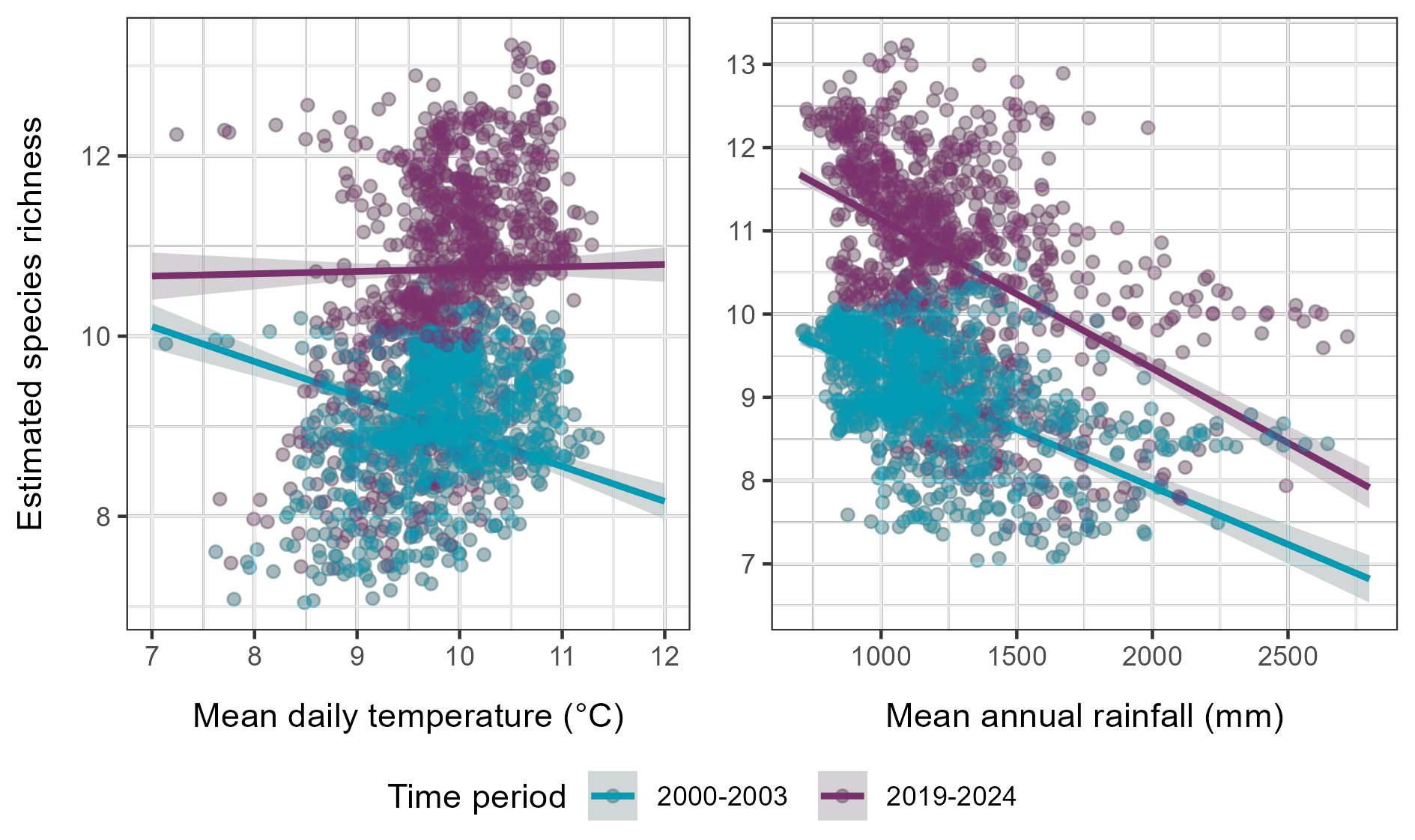
Partial effect plots showing the relationship between estimated species richness and mean daily temperature (left) and mean annual rainfall (right) in the time periods 2000–2003 and 2019–2024.
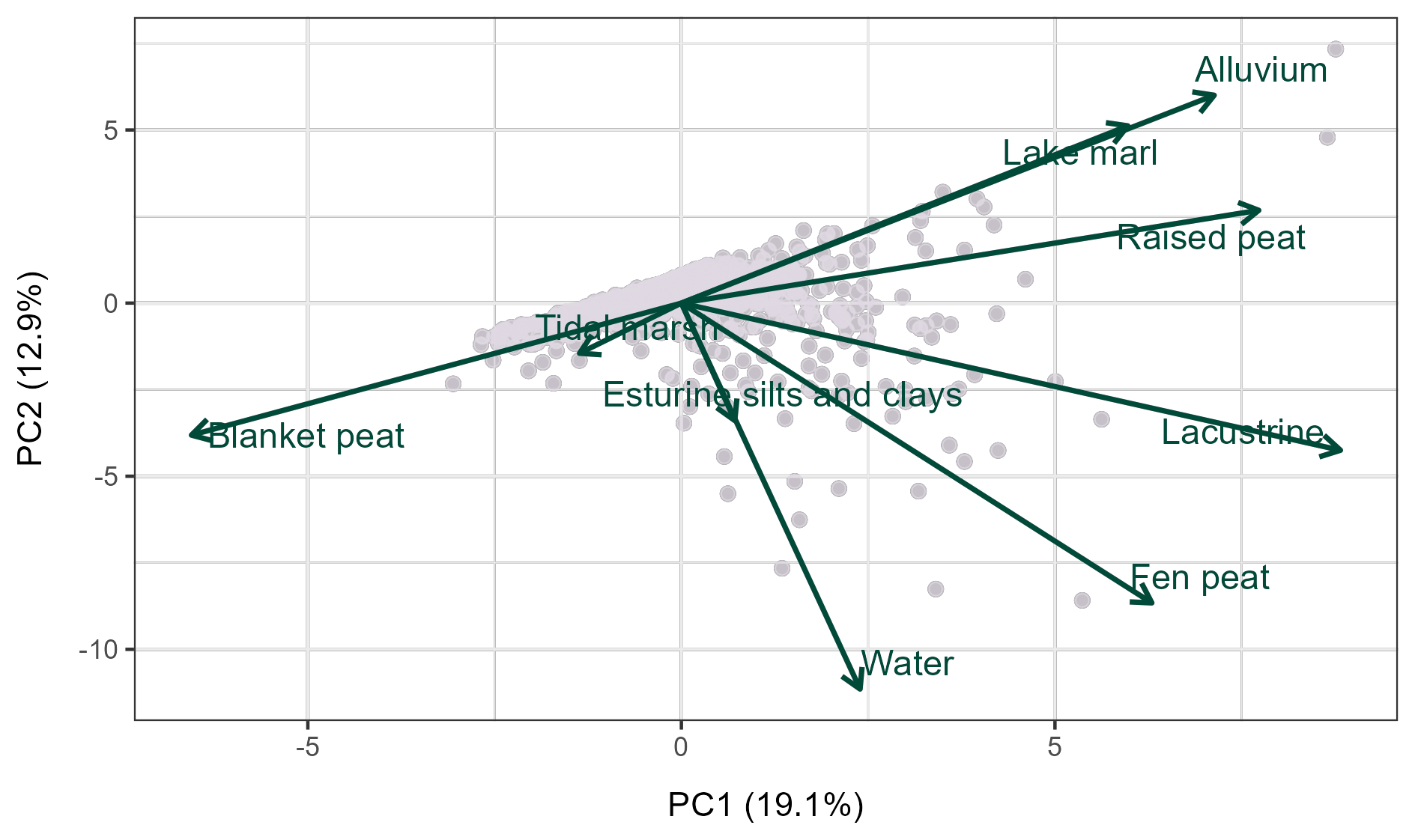
PCA biplot of wetland lithology principal components.
Looking ahead
The study provided the most statistically rigorous analysis yet of flight period change, climatic associations and species richness drivers in Irish dragonflies and damselflies, and offered clear pointers for future work. The flight period results in particular highlighted the importance of consistent early-season survey effort if phenological shifts are to be detected reliably as climate change progresses. The species richness models provide a strong foundation for more sophisticated spatial analysis. The overall findings are well placed to inform the forthcoming Dragonfly Ireland atlas, future Red List reviews and longer-term monitoring strategy.